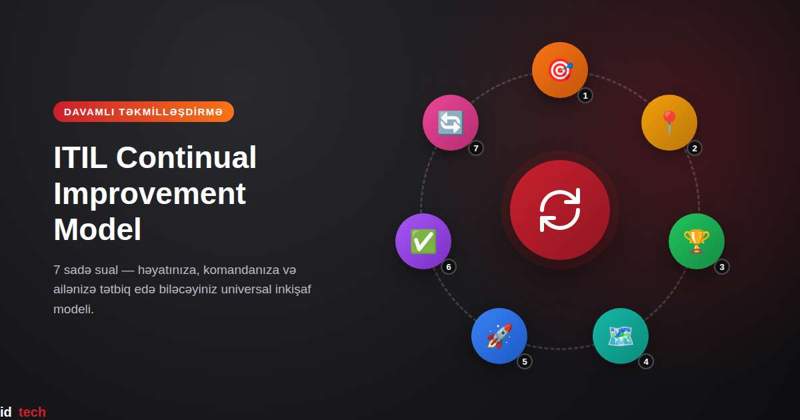

ITIL (IT Infrastructure Library) might seem, at first glance, like a framework meant only for IT service management professionals. But its "Continual Improvement Model" is actually a universal thinking tool — one you can apply to a project, a team, or even your own personal life.
The model consists of 7 simple questions. Let's walk through each one and see how it translates into everyday life.
🎯 1. What is the vision?
Every change starts with a question: "What do we want to achieve?" For a company, that might be "become the market leader." For an individual, it's "who do I want to be in five years?" A vision isn't a goal — it's more of a direction. For example, "I want to live a healthy lifestyle" is a vision, while "lose 5 kg in 3 months" is the goal that follows it.
📍 2. Where are we now?
Once the vision is set, it's time to face reality: what skills, resources, and time do we actually have? This step isn't about criticism or self-praise — it's simply an honest "audit." If you want to learn a foreign language, for instance, start by honestly assessing how many words you know and what level you can currently speak at.
🏆 3. Where do we want to be?
Here, the vision turns into concrete, measurable goals. The SMART framework (Specific, Measurable, Achievable, Relevant, Time-bound) is the most useful tool at this stage. Instead of "I want to improve my English," you'd say "I will learn 10 new words a day for the next 3 months."
🗺️ 4. How do we get there?
Now that the goal exists, a roadmap is needed. The most common mistake at this stage is poor prioritization. ITIL's "Focus on Value" principle is the key here: wherever you spend your energy should bring you and the people around you the most benefit — start there.
🚀 5. Take action
Planning is easy; execution is hard. The golden rule of this step is simple: keep moving, even if only a little, but consistently. Reading 10 pages a day without fail beats reading 200 pages once and then stopping — consistency wins in the long run.
✅ 6. Did we get there?
From time to time, it's worth pausing to evaluate: what did we do right, what would we do differently? This isn't about admitting failure — it's about gathering information to take the next step more wisely.
🔄 7. How do we keep the momentum going?
This is the most overlooked, yet most important, step. Once you've achieved a result, saying "we're done" is a mistake — the world is dynamic, and standing still is actually falling behind. To maintain and build on your progress, the model loops back to question one — "What is the vision?" — and the cycle continues.
You can apply this model not only to your personal goals but also to team management (for example, when planning your employees' professional development) or within your family (for example, when setting goals for your child's upbringing) — the structure stays the same, only the context of the questions changes.
📖 Author: Elbeyi Alisoy