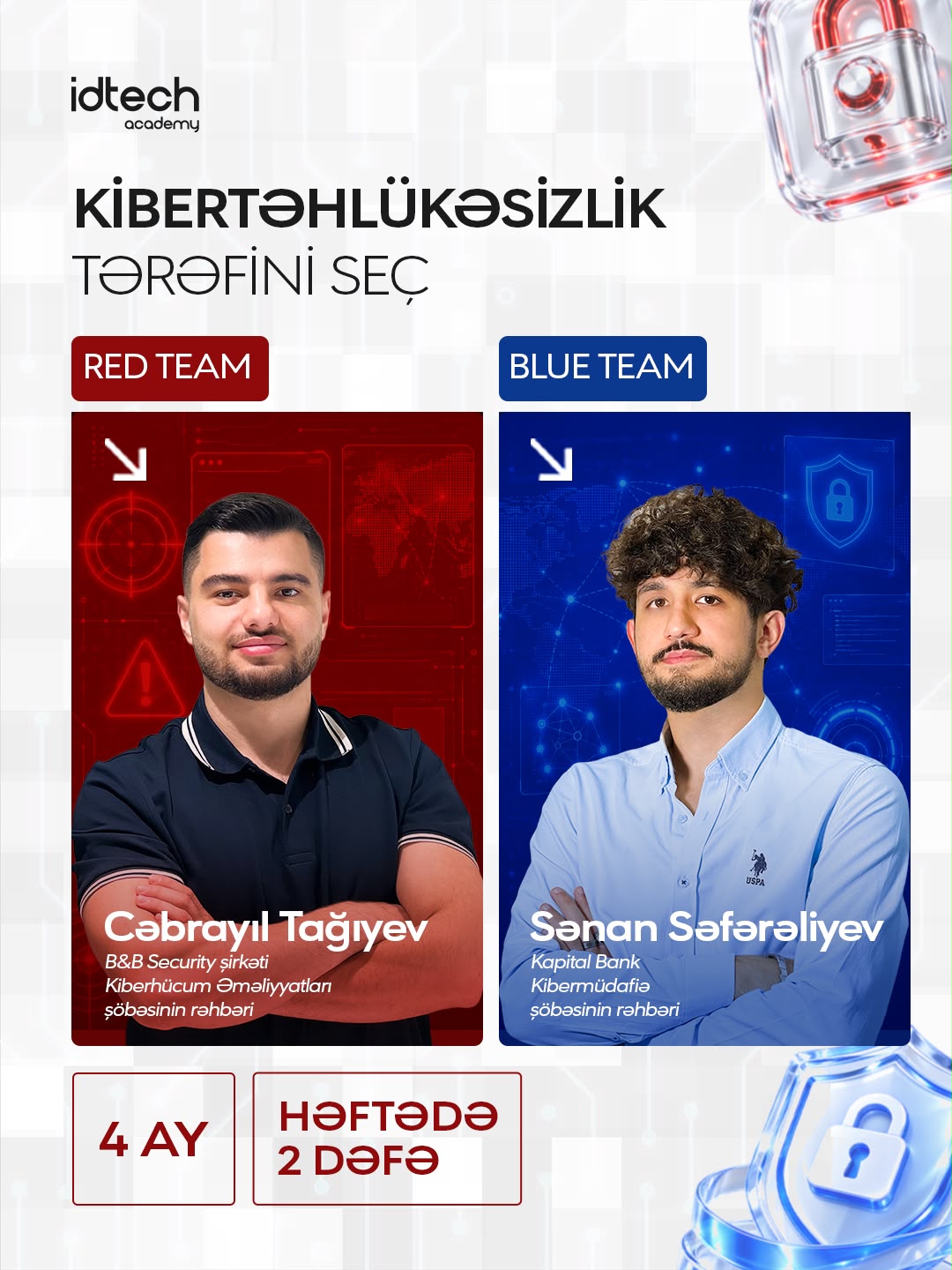

Red Team and Blue Team are two of the most widely discussed concepts in cybersecurity. In recent years, as companies have become more digital and the number of cyberattacks has grown, the role of these two teams has become increasingly important.
If you are thinking about starting a career in cybersecurity, becoming a Red Team or Blue Team specialist, or building a career in Cyber Security in general, the first thing you need to understand is the difference between these two directions.
In this article, we will look in detail at what Red Team is, what Blue Team is, what skills each requires, which tools they use, and which direction might be the right fit for you.
What Is Cybersecurity?
Cybersecurity (Cyber Security) is the field concerned with protecting computer systems, networks, servers and data from unauthorized access, data theft and various cyberattacks.
Today, almost every organization — banks, government agencies, hospitals, universities and technology companies — needs cybersecurity specialists.
Modern cybersecurity is no longer just about using antivirus software. The field also covers risk assessment, security architecture, monitoring, incident investigation and attack simulation.
This is where the concepts of Red Team and Blue Team come in.
What Is Red Team?
Red Team is a team of cybersecurity specialists who act like real attackers against an organization.
Their goal is to find security gaps in the company and attempt to gain access to its systems by exploiting them.
In other words:
Red Team is a team of "ethical hackers" who try to break into the company's security.
The key difference, however, is that Red Team does this with the company's permission.
Through these tests, a company can identify its weak points before a real attack happens.
What Does a Red Team Specialist Do Day to Day?
A Red Team specialist's job is not just about "hacking."
They:
- • research the company's infrastructure;
- • gather open-source intelligence (OSINT);
- • analyze security vulnerabilities;
- • carry out penetration testing;
- • prepare social engineering scenarios;
- • test Active Directory environments;
- • test web applications;
- • perform lateral movement within internal networks;
- • test privilege escalation scenarios;
- • prepare technical reports on their findings.
Red Team's main goal is not "breaking the system."
The main goal is to show security teams the weaknesses in the system.
What Is Blue Team?
If Red Team is the attacking side,
Blue Team is the defending team.
Blue Team's main goal is to protect the organization's information systems, detect attacks in time and minimize their impact.
They monitor systems 24/7, analyze logs, investigate security incidents and respond promptly to potential incidents.
In simple terms:
Blue Team is the team that guards the company's digital fortress.
What Does a Blue Team Specialist Do?
The daily work of Blue Team specialists can include:
- • security monitoring;
- • managing SIEM systems;
- • log analysis;
- • endpoint security;
- • firewall management;
- • configuring IDS and IPS systems;
- • incident investigation;
- • malware analysis;
- • developing security policies;
- • remediating vulnerabilities.
Their goal is to detect threats before an attack happens, not after.
Key Differences Between Red Team and Blue Team
🔴 Red Team:
- • Attacks
- • Looks for vulnerabilities
- • Performs penetration testing
- • Writes and uses exploits
- • Tests the target system
🔵 Blue Team:
- • Defends
- • Closes vulnerabilities
- • Performs monitoring
- • Builds security policy
- • Ensures the system's security
In reality, these two teams are not rivals.
They serve the same goal — improving the company's security.
What Is Purple Team?
In recent years, another concept has become widespread in cybersecurity:
Purple Team
Purple Team is not a separate team.
In this approach, Red Team and Blue Team work together.
For example:
Red Team carries out a specific attack.
Blue Team tries to detect that attack.
Then both teams analyze the results together and improve the defense mechanisms.
This kind of collaboration raises a company's security level much faster.
Skills Needed for Red Team
For those who want to become a Red Team specialist, the following knowledge is essential:
- • Linux operating system
- • Windows Server and Active Directory
- • TCP/IP and networking technologies
- • Web security
- • Penetration testing methodology
- • Bash and PowerShell
- • Python programming language
- • Privilege escalation
- • Basic concepts of exploit development
- • Active Directory attacks
Skills Needed for Blue Team
Those who want to grow in the Blue Team direction should focus on the following topics:
- • Windows and Linux administration
- • SIEM systems
- • Microsoft Defender
- • Splunk
- • QRadar
- • Microsoft Sentinel
- • Log analysis
- • Network security
- • Incident response
- • Digital forensics
- • Threat hunting
What Tools Does Red Team Use?
Red Team specialists use a variety of security tools.
For example:
- • Nmap
- • Burp Suite
- • Metasploit
- • BloodHound
- • Impacket
- • CrackMapExec
- • Hashcat
- • Hydra
- • Gobuster
- • Nikto
These tools are used to discover and test security vulnerabilities.
What Tools Does Blue Team Use?
For Blue Team, monitoring and analysis tools take center stage.
The most widely used tools include:
- • Microsoft Sentinel
- • Splunk
- • Wazuh
- • Elastic Stack
- • QRadar
- • Suricata
- • Zeek
- • Wireshark
- • Microsoft Defender XDR
These systems are used to detect and investigate security incidents.
Red Team, Blue Team and DevSecOps
In modern companies, security is no longer the job of a single, separate team.
In recent years, the DevSecOps approach has become widespread.
DevSecOps aims to integrate security into the software development process from the very beginning.
In this approach:
- • the DevOps team ensures automation;
- • Red Team evaluates attack scenarios;
- • Blue Team organizes monitoring and defense.
As a result, security is taken into account throughout the entire lifecycle of the software.
Which Direction Suits You Better?
If you:
- • enjoy investigating problems;
- • want to learn how systems are broken into;
- • are interested in ethical hacking,
then Red Team might be a better fit for you.
If you find:
- • security monitoring;
- • log analysis;
- • incident investigation;
- • protecting systems
more interesting, then the Blue Team direction suits you better.
Both fields are in high demand and offer strong prospects.
Career Opportunities in Red Team and Blue Team
The cybersecurity market continues to grow every year.
Job openings in these directions are increasing rapidly both in Azerbaijan and on the international market.
The most common positions include:
- • SOC Analyst
- • Security Analyst
- • Incident Response Analyst
- • Threat Hunter
- • Penetration Tester
- • Ethical Hacker
- • Red Team Operator
- • Blue Team Engineer
- • Security Engineer
- • Security Consultant
Opportunities to work remotely are also quite broad.
Certifications for Red Team and Blue Team
The following certifications can help advance your career:
Red Team
- • eJPT
- • PNPT
- • OSCP
- • CRTO
- • CEH
Blue Team
- • Security+
- • Blue Team Level 1 (BTL1)
- • SC-200
- • CySA+
- • GCIH
When choosing a certification, it's important to decide based on your goals and current level of knowledge.
Conclusion
Red Team and Blue Team are inseparable parts of the cybersecurity ecosystem.
Red Team learns how attackers think and puts systems to the test.
Blue Team, on the other hand, protects those systems, monitors them and builds defense mechanisms against potential threats.
For modern organizations, both directions are equally important. A strong cybersecurity strategy is not about attacking only or defending only — it requires applying both approaches in a balanced way.
If you want to build a career in cybersecurity, the most effective path is to first gain a solid foundation in Linux, networking technologies and operating systems, and then specialize in either Red Team or Blue Team based on your interests.